Relief Beyond Sciatica Symptoms
Sciatica and lower back pain don’t just make movement uncomfortable—they can affect how you sit, sleep, work, and live day to day. If you’ve tried stretching, rest, or quick fixes without lasting results, it may be time for a more targeted approach. Pilates for lower back pain and sciatica offers a safe, targeted way to reduce nerve compression, improve mobility, and restore functional movement.
At Dynamic Body Pilates, we focus on identifying the compensation patterns that keep you stuck in your pain.Then we use precise, low-impact movement to address how the entire body is contributing to your sciatica symptoms.
“Thanks to Dynamic Body Pilates I was finally able to reduce the sciatic pain that I’ve had for over 20 years! They are real professionals, who are especially adept at listening and teaching.” —Douglas G.
Understanding Sciatica Pain and Its Causes
Sciatica refers to pain that radiates along the sciatic nerve, typically running from the lower back through the hips and down one leg. It’s often caused by nerve compression or irritation in the lumbar spine.
Common causes include:
- Herniated or bulging discs
- Tight hip muscles (especially the piriformis)
- Poor posture and prolonged sitting
- Weak core and postural muscles
- Spinal misalignment or instability
Common symptoms:
- Sharp, shooting pain down the leg
- Tingling or numbness
- Muscle weakness
- Pain that worsens with sitting or bending
Modern lifestyles—especially long hours at a desk—can contribute significantly to these issues. When your core isn’t supporting your spine properly, surrounding muscles compensate, creating tension and increasing pressure on the nerve.
This is where Pilates stands out.
Unlike generic exercise programs, Pilates is low-impact, highly adaptable, and focused on restoring proper movement patterns, making it ideal for those dealing with both lower back pain and sciatica.
How Pilates for Lower Back Pain and Sciatica Helps Restore Movement
Pilates doesn’t just treat symptoms—it works to correct the underlying imbalances contributing to pain.
Core Strength to Reduce Spinal Pressure
A strong, properly engaged core stabilizes the spine and reduces unnecessary strain on the lower back, helping relieve pressure on the sciatic nerve.
Improved Hip Mobility
Tight hips are a major contributor to sciatic pain. Pilates incorporates controlled stretching and strengthening to restore mobility and reduce nerve compression.
Better Posture and Alignment
Poor posture—especially slouching or anterior pelvic tilt—can aggravate sciatica. Pilates for posture retrains your body to move and sit with proper alignment.
Gentle Spine Mobilization
Rather than aggressive stretching, an integrated approach to one-on-one Pilates uses controlled, supported movement to safely mobilize the spine and improve function.
Guided, Personalized Movement
One of the biggest advantages of Pilates is expert guidance from practitioners who are comprehensively certified in the full Pilates method. Exercises can be modified in real time to ensure they’re helping—not aggravating—your condition.
Targeted Pilates for Sciatica: Moving Beyond Basic Exercises
Many of the movements often recommended for sciatica—like bridges, pelvic tilts, and gentle spinal mobility—are helpful starting points. They’re commonly introduced in physical therapy and can play an important role in early relief.
At Dynamic Body Pilates, we build on that foundation.
Rather than just prescribing exercises, we focus on how your body is performing them—bringing more precision, awareness, and integration to each movement. This often reveals where compensation patterns are still present, even in familiar exercises.
From there, the work evolves.
We guide you toward more coordinated, full-body movement that supports long-term improvements in strength, flexibility, and balance—so you’re not just managing symptoms, but changing how your body moves overall.
How the Reformer Changes the Experience
The reformer allows us to take this work further by meeting your body where it is and helping it progress.
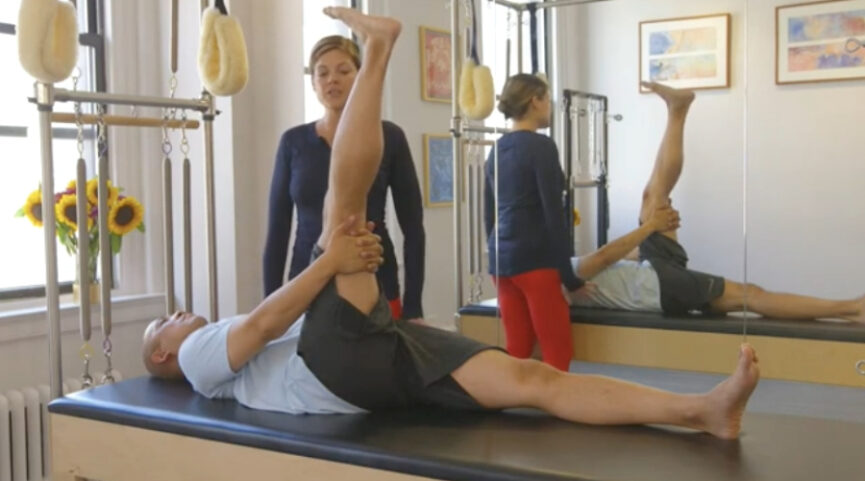
With its spring-based system, we can both assist and resist your movement, which creates a unique opportunity:
- Movements that may trigger sciatica on the mat or in standing can often be performed more comfortably
- The body experiences less compression and more support
- Alignment and control become easier to access and refine
With consistent, personalized guidance on the reformer, your body begins to recognize that it has options beyond bracing and compression—opening the door to more efficient, less painful movement patterns.
Want more? Read our tips for footwork on the reformer and why it matters.
Supporting Lasting Change During and After Sciatica
Rather than focusing on avoiding pain or limiting movement, our approach is about expanding what feels possible.
Each session is tailored to how your body is presenting that day, with careful attention to:
- How movement is being distributed throughout the body
- Where compensation patterns are still driving strain
- How to gradually reintroduce strength, mobility, and stability without triggering symptoms
This is what allows progress to continue beyond the initial relief phase—and supports more lasting change.
Choosing the Right Approach for Pilates for Sciatica Pain
Not all Pilates experiences are the same—especially when you’re dealing with pain.
Personalized vs. Group Sessions
If you’re experiencing active pain, personalized sessions ensure exercises are tailored to your body, movement patterns, and current limitations.
While group classes can be effective for general fitness, they often move at a set pace and aren’t designed to address individual injuries or imbalances. Without proper one-on-one guidance, it’s easy to compensate, use incorrect form, or push through movements that may exacerbate sciatica symptoms or increase lower back strain.
Beginning with a personalized approach allows you to build a strong, pain-free foundation, so you can move with confidence and control.
Why Comprehensive Certification and Private Sessions Matter
Comprehensively certified Pilates practitioners complete several hundred hours of training, along with continued education that deepens their ability to assess and understand movement over time.
That training changes how they see your body. In practice, that means looking closely at your biomechanics:
- Where you’re limited in flexibility
- Where you’re unstable or lacking support
- How you’re organizing movement, breath, and effort
They’re not working from symptoms or pulling from a set sequence of exercises—they’re observing patterns, compensations, and subtle imbalances in real time. It’s something clients often notice right away: “How can you see that?”
In a private session, that level of observation allows for more precise cueing, immediate adjustments, and progressions that are built around how your body actually moves—not just what it feels like.
In contrast, much of today’s Pilates landscape—especially in larger group reformer classes—is led by instructors with limited, apparatus-specific training. With under 100 hours of education, the focus is often on delivering a general workout that’s safe for already active participants, rather than individualized guidance for those working through pain or injury.
Comprehensively certified practitioners are trained very differently.
With a deeper education across all standard Pilates equipment—including reformer, cadillac, chair, and barrel—they develop a more complete understanding of biomechanics and how to adapt movement for the person in front of them.
Because no two bodies move the same—and resolving pain requires paying attention to those nuances, not working around them.
At Dynamic Body Pilates, that depth of training is paired with a focused approach to working with sciatica and low back conditions—bridging the gap between physical therapy and fitness in a way that is both thoughtful and progressive.
Mat Pilates: A Tool for Awareness and Integration
Mat work can be a powerful way to practice and reinforce movement patterns outside of sessions.
But how you perform the exercises matters more than the exercises themselves.
Many clients come in having done physical therapy or mat-based work before—but without ever being guided through the level of detail that changes how a movement actually feels. A small shift in alignment, muscle engagement, or breath coordination can completely change the experience.
That’s where progress begins.
It’s also important to note that traditional mat Pilates follows a fixed sequence of exercises developed by Joseph Pilates. While effective for some, many of these movements can be too advanced—or even compressive—for those dealing with sciatica or low back pain.
Our approach prioritizes your body’s current needs over any fixed sequence.
Reformer Pilates: Support, Precision, and Progression
The reformer can be an incredibly effective tool for relieving sciatica pain—but only when used with precision.
Its spring-based system allows us to both assist and resist your movement, which means:
- Exercises that may feel uncomfortable or triggering on the mat can often be performed with more support
- Your body can move with less compression and more control
- Strength, flexibility, and stability can be developed in a more progressive, adaptable way
But the machine itself isn’t the solution.
What makes the difference is how it’s used—how the exercise is set up, how your body is positioned, and how movement is being guided based on your specific limitations and compensations.
Finding the Right Frequency for You
After an initial Dynamic Body Assessment Session, most clients begin with 1–3 sessions per week for about 10 weeks.
There’s no single “right” frequency.
What matters most is finding a rhythm that works within your lifestyle—so you can be consistent and actually build momentum. If you’re able to start with a higher frequency, you’ll typically learn faster and benefit from more consistent, personalized feedback.
That said, even once per week can absolutely lead to meaningful progress.
The key is not perfection—it’s consistency, support, and building something that’s sustainable.
Building a Practice Beyond the Studio
What happens between sessions is just as important—but it doesn’t look the same for everyone.
Your at-home or between-session practice is shaped around your starting point:
- Are you already doing physical therapy exercises regularly?
- Do you have an existing workout routine?
- Or are you starting fresh with little to no structured movement?
- Is your schedule flexible—or already stretched thin?
Based on this, we guide you toward something that feels both useful and doable.
For some, that may include simple strength or mobility exercises. For others, it’s less about adding more—and more about integrating awareness into what you’re already doing.
What “At-Home Practice” Can Actually Look Like
Not all progress comes from structured workouts.
Sometimes it’s:
- Noticing how you’re standing while waiting at a stoplight
- Adjusting how you sit at your desk
- Bringing awareness to how you move through everyday tasks
Other times, it may be a short, focused set of exercises designed specifically for your body.
What matters is that it’s relevant, manageable, and something you’ll actually do.
Each week, we refine this together—so your practice continues to evolve as your body does.
Why This Approach Works
Rather than following a rigid schedule or checklist, this approach allows you to:
- Build strength, flexibility, and awareness at your own pace
- Stay consistent without feeling overwhelmed
- Reinforce new movement patterns in real life—not just in sessions
Because lasting change doesn’t come from doing more—it comes from doing what’s right for you, consistently.
Lifestyle & Posture Tips to Relieving Sciatica Pain
Pilates works best when combined with supportive daily habits.
Improve Your Desk Setup
While most people know to avoid slouching, it’s just as common to overcorrect—creating stiffness and tension by trying to “sit up straight” too rigidly.
Instead of forcing posture, focus on sitting with ease:
- Keep your feet grounded and hips supported
- Allow your spine to feel naturally upright—not rigid
- Avoid holding yourself in place
If you notice yourself bracing or “holding” your posture, come back to your breath. Taking slow, full inhales and exhales can help release tension and gently decompress your back—often more effectively than trying to sit perfectly.
Move More Throughout the Day
When possible, avoid prolonged sitting. Remaining seated for extended periods can stiffen the hips and lower back—creating an environment where sciatica symptoms are more likely to persist.
If your routine involves a lot of sitting, incorporate regular breaks to stand, walk, or shift positions. These small resets help re-engage the glutes and support more balanced movement throughout the day.
Find Relief with Pilates for Lower Back Pain
You don’t have to have sciatica and lower back pain for the rest of your life. With the right approach, you can reduce pain, move better, and build lasting strength.
At Dynamic Body Pilates, we specialize in helping clients move beyond temporary fixes and toward long-term relief through personalized, intelligent movement. Learn more about our Dynamic Body Assessment Session, and book a complimentary phone consultation with us to get started.
FAQs About Pilates and Sciatica Pain
Is Pilates good for sciatica relief?
Yes—but how it’s taught matters. Pilates that prioritizes biomechanics, core and breath integration, hip and back support, and postural awareness can help reduce strain and support more efficient, less painful movement.
Can Pilates cure sciatica?
Pilates can significantly reduce or eliminate symptoms by addressing underlying imbalances, though results depend on the cause and severity.
Which Pilates exercises should I avoid with sciatica?
Avoid movements that involve deep forward flexion, twisting under load, or any exercise that triggers sharp or radiating pain.
How often should I practice Pilates for lasting relief?
Most people benefit from 1–3 sessions per week, combined with consistent daily movement.
Do I need a reformer, or is mat Pilates enough?
Both can be effective. Ultimately, reformer Pilates with precise instruction is the most effective.
Is it safe to start Pilates if my sciatica is severe?
If you have severe pain, we may ask that you have medical clearance before beginning Pilates. Pilates can be helpful, but starting with a guided, personalized session is strongly recommended to avoid aggravating symptoms.
How soon can I expect to feel improvements?
Some people notice relief within a few sessions, while others see gradual improvement over several weeks with consistent practice.
Do you work alongside my physical therapist or other healthcare providers?
Yes—very often. Many of our clients are already working with physical therapists, massage therapists, acupuncturists, or chiropractors, and we see our work as complementary to that care.
While those practitioners may focus on treating symptoms, relieving pain, or restoring function in specific areas, we focus on how your body moves as a whole. Full-body movement mechanics are often the missing link—helping you integrate those improvements into everyday movement so they actually last.
When appropriate, we’re happy to collaborate as part of your broader care team to support more complete, long-term progress.

Rebecca Lubart is the founder and CEO of Dynamic Body Pilates, a one-on-one Pilates studio in New York City specializing in chronic pain, movement challenges, and healthy aging. With 20 years of experience teaching Pilates, Rebecca helps people better understand how their bodies move—and how strength, mobility, balance, and coordination work together.
Her approach grew in part from her own recovery from a traumatic injury and the search for more effective, whole-body solutions to persistent pain. She founded Dynamic Body Pilates in 2012 to bring that approach to others. Today, Rebecca and her team help clients move with greater comfort, confidence, and independence through highly individualized Pilates and movement education.