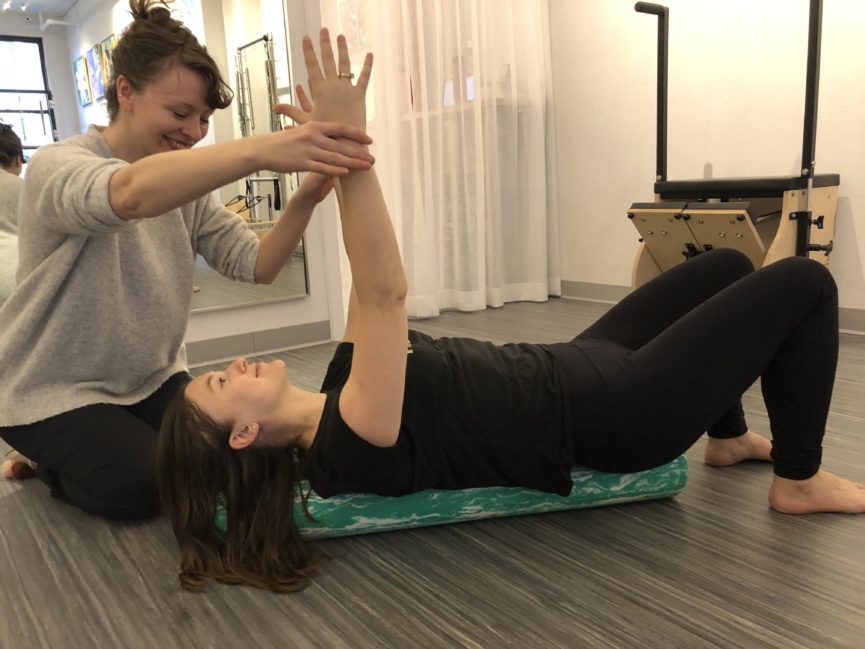
Well+Good recently stopped by for a Dynamic Body Assessment Session to ask me about posture and restorative exercise. I’m telling you, busy stressed-out overworked New Yorker, I have the one exercise that will change your life… and don’t hate me for this, but it involves doing almost nothing. You just need a full-length (36 x 6 inch) foam roller.
Foam Roller Pilates for Restorative Exercises
Rachel walked into our pilates studio in her leggings and tank top, water bottle in tow. She’s a pretty diligent exerciser, consistently in HIIT classes or out for a run, but she tells me she’s not getting enough restorative movement in.
It’s really telling about our values around health and wellness that the “harder” stuff so often gets prioritized. But hard or restorative, it’s all part of the larger picture of self-care, and your body needs both. As go-go-go New Yorkers, many of us need more restorative in our lives to reach our goals whether weight loss, less stress, or better productivity. Instead of giving our hyper-charged nervous systems a chance to calm down we think, “I have to burn-sweat-work more,” when what would benefit us the most is to make sure we’re working smarter.
A runner and a New Yorker, Rachel spends a fair amount of time out on the concrete and treadmill, so having a conversation with her calves was a must. They are the area least likely to tell you they are tight, but a major contributor to low back and neck tension – something she did not need more of.
…her face scrunched up as she felt all the tension she hadn’t even noticed before…
How to use a foam roller for pilates
We had her on her shins with a half foam roller (flat side toward the hamstring and round side towards the calf) and breathe. Slowly shifting her weight side to side like she was mushing her calf muscle over the bone, her face scrunched up as she felt all the tension she hadn’t even noticed before. I cued her to tune into breathing to release the tension and notice how instead of releasing the tension her tendency was to transfer it into her neck and back.
Simple, easy-to-do exercises for foam roller pilates
We moved through the other Pilates equipment, including the reformer, to execute a series of specific stretching, strengthening, coordination, and postural awareness exercises. Rachel was surprised by these seemingly simple exercises – once we got her body properly aligned, performing them turned out to be quite challenging. Who knew restorative work could also be a work out? I knew what she needed next before she left the studio.
This is the one exercise that will change your life and it takes absolutely no (read ZERO) effort to do. Are you ready?
Lie down on your back with your foam roller reaching from your head to your tail along the length of your spine. Done. That is all you have to do. REALLY.
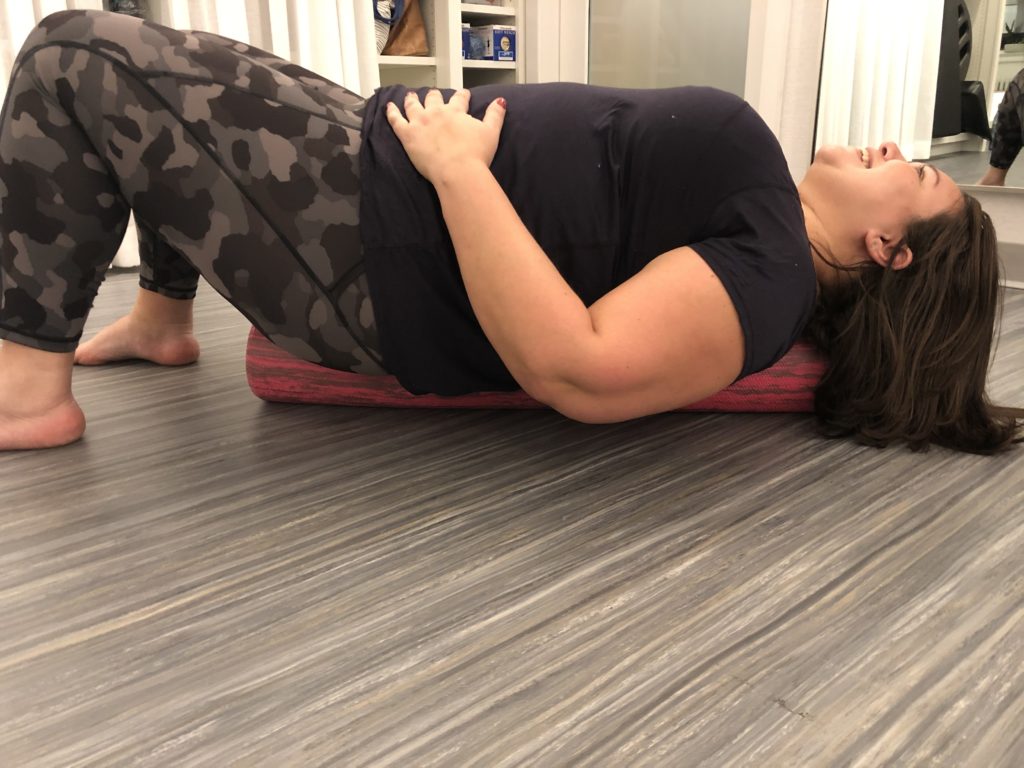
Here’s why. The act of lying down on your foam roller is going to be a big shift for your spine and body at the end of your day of standing up, sitting at your desk, hovering over your devices, and fighting gravity. It’s super relaxing. However, because it is a little bit unstable, you can’t completely check out! You can almost check out, but your body knows that the one task it has is not to fall off…and that’s easy.
Why pilates on a foam roller is so effective
On your foam roller, your deep spine stabilizers are active, and gravity is finally the friend of all those back muscles you’ve been overworking to stay upright all day long. Your chest can’t help but open up a bit and your breath slowly starts to become fuller and deeper. It is natural to find yourself wanting to move your body around (shifting side to side, or moving your arms and legs) so it’s also a bit of a sneak up on getting yourself to do more.
When you get up, you might feel a little lighter, like you were floating on a cloud. Congratulations, you just successfully decompressed your spine, calmed your mind and body, and all you had to do was lie there. A-MAZING.
Techniques to address specific problem areas with pilates on the foam roller
Try out the following list of additional restorative exercises I offered to Well+Good for their article by Rachel Lapidos, HOW TO DECOMPRESS YOUR SPINE USING A FOAM ROLLER, ACCORDING TO A PILATES PRO
1. Breathing
It sounds too good to be true, but “you can benefit from just lying down on a foam roller and breathing,” says Lubart. Make sure the roller is underneath your butt and your head with your knees bent, feet on the floor. “Gravity will help the roller disarm your overworked back muscles all up and down the spine.” To deepen your breathing, Lubart recommends directing the air into your belly, like you would in a yoga class.
2. Cactus Stretch
Goal post your arms to open up your chest. “Reach your arms out to the sides, keeping your elbows bent at a 90-degree angle,” says Lubart. “Your goal is to get your fingernails to touch the floor. Breathe in and on the exhale try to release the breastbone and front ribs down toward each other.” Hold each goal post for three full breath cycles. Deepen it by raising your arms from goal post position to straight up, or in a “Y” shape. “Try to keep touching the floor as you slide your arms long, then slide back into goal post.”
3. Knee Folds
“Fire up a little more of your musculature for even better relief of those achey spots,” says Lubart, who recommends using your core to lift one leg into table top (knee above the hip), then release and shift to the other leg while maintaining balance. “Make it your goal to not shift off-center on the roller as you lift each leg,” she says. “Keep everything but your breath and moving leg totally still.”
4. Arm Circles
“Bring your arms around you like you’re giving yourself a hug, then take them over your head like you’re taking off a sweatshirt,” says Lubart. Then circle your arms like a snow angel down besides your hips. Cross your arms over your body again and repeat about five times before reversing the circle. “Let your upper back fall into the roller,” she says.
To read the full article click here
Want more restorative exercises? Check out our Top 3 Heart-Openers
Get Guidance from a Personalized Pilates Trainer
Working with a personalized Pilates trainer can help you get the most out of your practice on the roller. A trainer will guide you through targeted movements that release tension, improve alignment, and activate deep stabilizing muscles, allowing you to experience the full restorative benefits of Pilates on the roller. With expert support, you’ll move more mindfully and achieve better results for your body and mind.
Learn more about our pilates services and how to get started.
FAQs About Foam Roller Pilates & Restorative Movement
Do I actually need a foam roller for Pilates, or is it optional?
You don’t need one—but it changes everything about how your body experiences support. A full-length foam roller helps create gentle instability so your deep stabilizing muscles naturally engage while the rest of your system can start to let go. At DBP, we use it as a tool for both release and awareness, not just stretching.
Why does lying on a foam roller feel so intense if it’s supposed to be restorative?
This is one of the most common reactions. What feels “simple” on the surface often reveals hidden tension patterns underneath. When you lie on the roller, your body suddenly has feedback it doesn’t usually get on flat ground. That’s why you might feel shaking, tightness, or even emotional release—it’s your nervous system recalibrating, not just your muscles stretching.
Can foam roller Pilates actually help with posture?
Yes—but not by “forcing” posture into place. Instead, it helps you feel alignment from the inside out. When you’re on the roller, your body has to self-organize around gravity, which brings awareness to ribs, pelvis, and spine positioning. Over time, that awareness translates into how you sit, stand, and move throughout the day.
I already do HIIT/running—do I still need something this gentle?
Especially if you’re doing high-intensity training, yes. Many people in fast-paced workouts build strength but miss restorative input. Foam roller Pilates balances that by downshifting the nervous system, improving tissue quality, and helping your body actually recover so you can keep performing without compensation patterns building up.
Why do my calves, hips, or back feel so tight when I try foam roller exercises?
Because those areas are often overworking for other parts of your body. For example, tight calves can contribute to low back or neck tension without you realizing it. On the roller, you’re not just “stretching” them—you’re reorganizing how load is distributed through your whole system.
Is it normal to feel like I’m doing “nothing” but still get tired during foam roller Pilates?
Yes. Sometimes that feeling comes from the nervous system finally relaxing enough for you to actually feel your underlying fatigue. Other times, the body is working much more deeply than it appears. Even small movements on the roller require significant stabilization, coordination, and control.
What’s the simplest foam roller exercise I can start with?
Start with this: lie on your back with the foam roller running along your spine from head to tailbone. Bend your knees and let your body settle. Then just breathe. That alone helps decompress the spine, open the chest, and signal the nervous system to downshift.
At DBP, we often call this the “do almost nothing” reset—but it’s doing more than it looks like.
How does breathing change things on the foam roller?
Breathing becomes more three-dimensional. Because the roller gently supports your spine, your ribs and diaphragm can expand more fully. Many people notice they’ve been breathing shallowly without realizing it—especially under stress. The roller helps retrain that pattern without forcing it.
Can foam roller Pilates replace stretching or physical therapy?
Foam roller Pilates is best viewed as another tool that supports overall wellness and movement quality. It can complement stretching, strength work, Pilates, and physical therapy by improving coordination, stability, mobility, and body awareness.
What makes foam roller Pilates different from regular stretching?
Traditional stretching focuses mostly on lengthening muscles. Foam roller Pilates combines strength, flexibility, balance, and coordination at the same time, helping the body work more as an integrated whole. That often creates more lasting stability and reduces the tension patterns that contribute to feeling tight in the first place.
Why do I feel lighter or taller after just a few minutes on the roller?
Because your spine has been gently decompressed and your breathing has shifted. When tension in the front body (chest, hips, calves) starts to release, the back body doesn’t have to work as hard to hold you upright. That change in effort can feel like lightness or space in your body.
Can foam roller Pilates help with stress or anxiety?
It can support regulation of the nervous system. The combination of supported lying, rhythmic breathing, and subtle movement signals safety to the body. That shift can reduce physical tension patterns that are often tied to stress, especially in the neck, jaw, and lower back.

Rebecca Lubart is the founder and CEO of Dynamic Body Pilates, a one-on-one Pilates studio in New York City specializing in chronic pain, movement challenges, and healthy aging. With 20 years of experience teaching Pilates, Rebecca helps people better understand how their bodies move—and how strength, mobility, balance, and coordination work together.
Her approach grew in part from her own recovery from a traumatic injury and the search for more effective, whole-body solutions to persistent pain. She founded Dynamic Body Pilates in 2012 to bring that approach to others. Today, Rebecca and her team help clients move with greater comfort, confidence, and independence through highly individualized Pilates and movement education.