At a Glance
- Client: A.G.
- Goal: Stay active, maintain her physical health, and feel confident in her changing body throughout her first pregnancy
- Challenge: She had previous group Pilates experience but wasn’t sure how exercise should change as her pregnancy progressed
- Approach: Individualized prenatal Pilates that evolved throughout pregnancy, combining strength, mobility, breathing, functional movement, and preparation for the physical demands of caring for a baby
- Outcome: A.G. remained active through 42 weeks of pregnancy, reported feeling good physically and mentally, and said the work gave her confidence to continue moving throughout pregnancy
A.G. came to Dynamic Body Pilates at 18 weeks pregnant with a straightforward goal: she wanted to keep exercising and feel physically capable throughout her first pregnancy.
What she didn’t have was confidence about how to do that as her body changed.
Over the following months, her one-on-one Pilates sessions evolved with her pregnancy—helping her maintain strength and mobility, become more comfortable with movement, and prepare for some of the real physical demands of childbirth, recovery, and caring for a baby.

The Challenge: How Do You Keep Exercising When Your Body Is Changing So Quickly?
Before pregnancy, A.G. had regularly taken group Pilates classes. But her first trimester had been difficult, and walking had sometimes been the extent of her exercise.
By 18 weeks, she was ready to become more active again. She also had questions.
Was it safe to engage her abdominal muscles? How should she move as her belly grew? What should she change? What did she need to prepare for?
Her intake captured her primary concern simply: “Changing body due to pregnancy.”
And when asked what she hoped to gain from working with Dynamic Body Pilates, her answer was equally clear:
“Further body confidence during pregnancy.”
Assessing Practitioner and DBP founder Rebecca Lubart noted that because this was A.G.’s first pregnancy, she had thoughtful questions about core engagement, posture, functional movement, and how exercise should evolve as her baby and belly grew.
Rather than asking A.G. to follow a predetermined prenatal workout, her practitioners could watch how she moved, answer the questions that came up, and continually modify the work based on her stage of pregnancy, comfort, strength, and confidence.
The Approach: Prenatal Pilates That Changed as Her Pregnancy Changed
A.G.’s program wasn’t the same at 18 weeks as it was one month before delivery.
That was the point.
Early in her work at DBP, sessions helped her become familiar with movement again while building confidence in what her pregnant body could do.
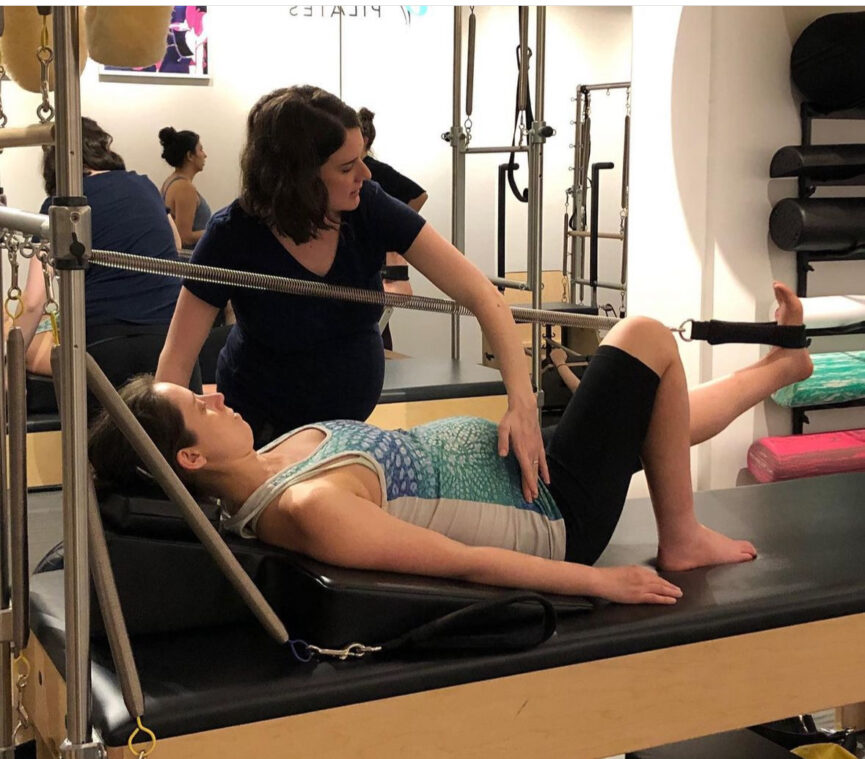
Her initial program included Reformer footwork, standing squats, spinal mobility, gentle upper-body strengthening, calf work, and breathing exercises. Because she had concerns about what was appropriate for her abdominals during pregnancy, her practitioners could address those questions directly while helping her understand how movement could support her as her body changed.
Early on, A.G. asked questions such as, “Is it safe to be engaging my core?”
By April, A.G.’s practitioner was seeing that uncertainty begin to shift. Although deep diaphragmatic breathing was still challenging, she noted that A.G. was “finding more confidence in this.”
That growing confidence became one of the clearest outcomes of the work:
“I am grateful that due to your expertise I felt comfortable with movement and staying active.”
Adapting Pilates to a Changing Body
Pregnancy brings continual physical changes, which meant A.G.’s Pilates program needed to evolve along the way.
Her sessions incorporated exercises for her legs, glutes, arms, shoulders, and upper back alongside mobility work for areas that were becoming tighter or working differently as her posture changed.
Her practitioners also paid attention to details specific to her: adjusting positions around her growing belly, giving her breaks when needed, responding to her concern about abdominal doming, and modifying pressure around an arm where she’d previously had surgery.
As delivery approached, A.G.’s practitioner had her practice holding a 10-pound weight “as if it were a baby” while walking, sitting, standing, putting it down, picking it back up, and gently bouncing it.
The goal was not simply to keep A.G. exercising. It was to help her continue moving in a way that felt appropriate for her changing body while also preparing for physical demands that were coming next.
Supporting Physical and Mental Well-Being
In her session notes, A.G.’s practitioner described her larger goal as preparing for birth while maintaining her health “physically and mentally.”
By the end of her pregnancy, A.G. reported that she felt great in her body and was in good physical and mental condition.
“I had a healthy pregnancy and felt great in my body and am also feeling good now.”
She also recognized that pregnancy and birth outcomes involve many factors beyond preparation. Her perspective was not that Pilates guaranteed a particular outcome, but that the months of working with Dynamic Body Pilates contributed to how prepared and confident she felt.
“While I don’t want to discount the role of luck … I am sure that working with you contributed to my good physical (and mental) condition.”
A 42-Week Pregnancy and a Physically Intense Labor
A.G.’s baby was born at approximately 42 weeks of pregnancy. She described labor as more physically intense than she had anticipated. Despite that intensity, the birth itself went smoothly, and both A.G. and her baby were healthy.
For us, that distinction matters.
The purpose of prenatal Pilates isn’t to promise a particular birth experience. It’s to help someone enter that experience feeling connected to their body, physically capable, and confident using movement as their body changes.
The Results
For A.G., the success of her Pilates experience was not defined by a single moment. It was the combination of feeling strong, comfortable, and confident throughout pregnancy and entering childbirth feeling physically and mentally well prepared.
Her experience included:
- A healthy pregnancy
- Feeling good in her body throughout pregnancy
- Maintaining confidence with movement and physical activity
- Feeling physically and mentally well at the end of pregnancy
- A smooth birth despite a physically intense 22-hour labor
- Both mother and baby healthy after delivery
- A desire to return to Pilates once she was cleared for exercise and had childcare in place
Continuing the Work Postpartum
A.G.’s story didn’t end at delivery. When she returned postpartum, her body needed something different again. She was rebuilding strength after childbirth and experiencing diastasis, so her practitioner’s guidance was to “take it easy, small, and slow to rebuild strength.”
Rather than immediately returning to strenuous abdominal choreography, sessions focused on breathing, pelvic movement, gentle abdominal coordination, footwork, glute strength, shoulder mobility, and gradually reconnecting with her core. That evolution—from an active second trimester, through late pregnancy, and into postpartum recovery—is exactly why individualized Pilates can be particularly useful during this stage of life.
The appropriate exercise isn’t determined simply by whether someone is “prenatal” or “postpartum.” It depends on the person standing in front of us that day.
Confidence to Keep Moving, Every Step of the Way
A.G. initially came to Dynamic Body Pilates because she wanted to exercise during pregnancy. What she gained was something more specific: confidence in how to keep moving as her body changed.
Her program included Pilates equipment, strength work, mobility, breathing, balance, and practical movements that prepared her for everyday physical demands. Just as importantly, the work changed over time—from rebuilding an exercise routine during her second trimester, to preparing for delivery late in pregnancy, to gradually rebuilding strength postpartum.
That’s the advantage of personalized prenatal and postpartum Pilates. There isn’t one prenatal workout that every pregnant person needs. There is the body you have, the stage you’re in, the goals that matter to you, and a program that can evolve alongside all three.
Interested in Personalized Prenatal or Postpartum Pilates?
Every pregnancy, recovery, and body is different. Dynamic Body Pilates provides individualized, private Pilates instruction designed around your body, goals, experience, and stage of pregnancy or postpartum recovery. Learn more about our prenatal and postpartum Pilates and how personalized instruction can support you through each stage.
Schedule a complimentary 15-minute call with Rebecca to talk about your goals, ask questions, and see if working together is a good fit.
Rebecca Lubart is the founder and CEO of Dynamic Body Pilates, a one-on-one Pilates studio in New York City specializing in chronic pain, movement challenges, and healthy aging. With 20 years of experience teaching Pilates, Rebecca helps people better understand how their bodies move—and how strength, mobility, balance, and coordination work together.
Her approach grew in part from her own recovery from a traumatic injury and the search for more effective, whole-body solutions to persistent pain. She founded Dynamic Body Pilates in 2012 to bring that approach to others. Today, Rebecca and her team help clients move with greater comfort, confidence, and independence through highly individualized Pilates and movement education.