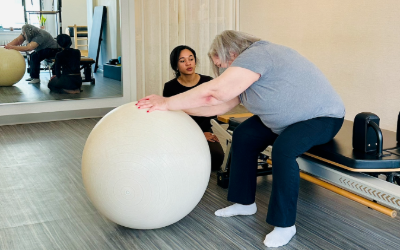
Physical therapy and Pilates often share the same goals—less pain, better function, greater strength, and more confident movement. What differs is the framework: PT provides clinical rehabilitation within a healthcare setting, while Pilates uses a comprehensive movement and exercise approach to help you build those capacities throughout your whole body.
For some people, the immediate need is rehabilitation. For others, it is figuring out how to exercise well in a body with a history of back pain.
Chronic Back Pain Doesn’t Always Feel Like an Injury
Many people who come to Dynamic Body Pilates have lived with back pain for years. They work, travel, raise families, sit at desks, and stay active. At some point, they may stop thinking of themselves as injured. They simply know their current way of exercising isn’t working particularly well anymore.
A postpartum mother may be ready to exercise but struggling to reconnect with her abdominal strength.
Someone may have had a herniated disc in their 30s, now be in their 50s with a desk job, and realize they need more movement and strength.
Another person may avoid exercise altogether because they’re afraid their back will flare. If that sounds familiar, it may also be helpful to understand whether Pilates can make back pain worse and why the way Pilates is taught matters.
As Dynamic Body Pilates founder Rebecca Lubart explains:
“Chronic back pain can become so familiar that people stop thinking of themselves as injured. They just start organizing more and more of their life around what their back will tolerate. Pilates gives us a way to expand what their body can do again.”
Where Physical Therapy Fits
Physical therapy is licensed healthcare. A physical therapist can clinically evaluate a musculoskeletal problem and develop a rehabilitation plan that may include exercise, education, neuromuscular work, and hands-on or manual treatment.
Pilates can address many of the same movement qualities—strength, mobility, coordination, balance, posture, and function—but through a different framework.
At DBP, Pilates becomes a way to understand how the whole body moves and progressively build what it needs.
When PT Works—but You Still Need Somewhere to Go
We see this frequently.
Someone does PT. Their back feels better. They return to their previous exercise routine.
Then the pain comes back.
They return to PT, improve again, go back to what they were doing—and eventually realize they are repeating the cycle.
That does not mean physical therapy failed. The missing piece may be what happens between feeling better and returning to fitness.
Other people finish PT with useful foundational exercises but don’t know how to progress them—or are afraid to because they don’t want to hurt themselves again.
Rebecca puts it this way:
“There can be a big gap between being out of pain and being ready for fitness. At some point, we have to figure out how to build beyond that baseline without returning to the same patterns that keep aggravating your back.”
Pilates can gradually build from that baseline into more resistance, endurance, balance, coordination, rotation, and whole-body movement.
One DBP client described that role simply:
“I highly recommend DBP if you want to ease an injury prone body back to your regular workout routine.” — Maida S.
Your Back Pain Doesn’t Have to Become Your Entire Workout
Pain can change the way you move. You may brace, shift your weight, avoid certain movements, or ask another area of your body to take over. Sometimes those strategies stick around even after the original pain improves.
That is why our assessment looks beyond the low back—at posture, hips and legs, rib cage and pelvis, breathing, strength, and how the whole body coordinates movement.
But a lot of our clients also don’t want another hour devoted entirely to their back.
They want stronger arms and legs. Better balance. More endurance. A stronger core. They want to run, travel, lift weights, play sports, or simply feel fit as they age.
Their back matters.
But their back is part of a whole body that also needs exercise.
Pilates gives us a way to build that complete workout while still responding to the movement patterns connected to the back pain.
Pilates and Physical Therapy Can Work Together
This does not have to be an either/or choice.
Someone may work with a physical therapist on a clinical problem while using Pilates to exercise more comprehensively.
One DBP client came to us through exactly that pathway:
“My physical therapist referred me to DBP. I have a back issue which sometimes flares up and impacts my daily routine. The sessions have helped me strengthen my core, increased my energy and provided me with coping strategies. Additionally, exercising here is fun!” — Joan S.
When someone is doing both, we want to understand what their physical therapist is working on and how the Pilates program can complement that care.
So, Pilates or Physical Therapy for Back Pain?
Physical therapy and Pilates can work toward many of the same outcomes. What differs is the framework.
If you need clinical evaluation, medical rehabilitation, or hands-on treatment, physical therapy offers resources Pilates does not.
If you need a comprehensive exercise approach that addresses your back pain while also building whole-body strength, mobility, endurance, coordination, and fitness, individualized Pilates may offer what you need.
And for some people, both belong in the plan.
If you are considering Pilates after physical therapy or looking for a more complete way to exercise with a history of back pain, the next question is who should guide you. Learn what to look for in a Pilates instructor if you have back pain, including the experience and individualized approach that can make a difference.
Ready to Move Beyond Managing Your Back?
At Dynamic Body Pilates, we work one-on-one with people who want to get stronger, move more freely, and return to the activities they care about without making their back the center of every workout.
Every client begins with a 90-minute Dynamic Body Assessment that looks at how your whole body moves, not just where you feel pain. From there, your sessions are designed around your movement patterns, goals, fitness level, and history.
If you’re not sure whether individualized Pilates is the right next step after PT, start with a complimentary 15-minute call. We can talk through where you are now, what you want to get back to, and whether DBP is a good fit.
FAQs About Pilates vs. Physical Therapy for Back Pain
Is Pilates better than physical therapy for back pain?
Pilates and physical therapy serve different purposes, so one is not inherently better than the other. Physical therapy provides clinical evaluation and rehabilitation, while individualized Pilates focuses on building strength, mobility, coordination, and whole-body fitness. Some people benefit from both, particularly when they are transitioning from rehabilitation back to regular exercise.
Can I do Pilates after physical therapy for back pain?
Yes. Pilates can be a useful next step for people who have completed physical therapy and want to continue building strength, mobility, coordination, and fitness. An individualized program can also help bridge the gap between completing rehabilitation exercises and returning to a broader workout routine.
Should I do physical therapy or Pilates for chronic back pain?
It depends on what you need. If you have an active injury or condition that requires clinical evaluation and rehabilitation, physical therapy may be appropriate. If you are looking for individualized exercise to build strength and movement capacity while working with a history of back pain, Pilates may be appropriate. In some cases, the two can complement each other.
Can Pilates help prevent back pain from coming back?
Pilates cannot guarantee that back pain will not return, but individualized exercise can help you build strength, mobility, coordination, and movement capacity. For someone with recurring back pain, the goal may be to develop a stronger, more capable body while learning how to exercise in ways that support their individual needs.
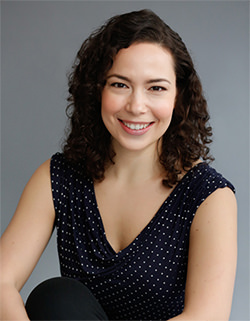
Rebecca Lubart is the founder and CEO of Dynamic Body Pilates, a one-on-one Pilates studio in New York City specializing in chronic pain, movement challenges, and healthy aging. With 20 years of experience teaching Pilates, Rebecca helps people better understand how their bodies move—and how strength, mobility, balance, and coordination work together.
Her approach grew in part from her own recovery from a traumatic injury and the search for more effective, whole-body solutions to persistent pain. She founded Dynamic Body Pilates in 2012 to bring that approach to others. Today, Rebecca and her team help clients move with greater comfort, confidence, and independence through highly individualized Pilates and movement education.