Yes. Pilates can aggravate back pain when an exercise repeatedly recreates the same tension, compensation, or movement pattern that makes your back hurt. This can be especially confusing because many people come to Pilates after being told they need a “stronger core.”
So you find a core exercise—maybe the Hundred, Single-Leg Stretch, Criss-Cross, or a dead-bug variation. You do it because it is supposed to help your back. And your back hurts.
You wonder:
- Am I doing this right?
- Should I keep doing it until it stops hurting?
- If it doesn’t feel like it’s helping, should I keep going?
These are questions I’ve heard repeatedly in nearly 20 years of working with people with back pain.
Rather than simply adding more repetitions, we want to understand how your body is creating the movement and what happens as you fatigue.
More Core Exercises Aren’t Always More Core Strength
Core strength can absolutely matter for back pain.
But doing more abdominal exercises does not guarantee that you are continuing to strengthen your abdominals.
I saw a perfect example recently during a Dynamic Body Assessment Session with a new client in her late 50s. She had a history of chronic low back pain, was returning to structured exercise, and specifically wanted to strengthen her core.
During one abdominal exercise, she felt great. Her abs were working and the movement looked well organized.
Then we tried to build on it.
Very quickly, her abdominal muscles reached their current endurance limit. They were no longer contributing in the same way, and her back began taking over.
She wasn’t in pain.
But if we had simply continued stacking similar abdominal exercises, her back increasingly would have been doing work we intended her core to do.
That isn’t building more abdominal strength. It is practicing a compensation pattern.
As Dynamic Body Pilates founder Rebecca Lubart explains:
“Her abs had done what they could do that day. The answer wasn’t two, five, or ten more abdominal exercises. Her starting point was figuring out how to keep building strength without asking her back to take over.”
So we changed direction.
Your Back-Pain Workout May Not Look Like a Core Workout
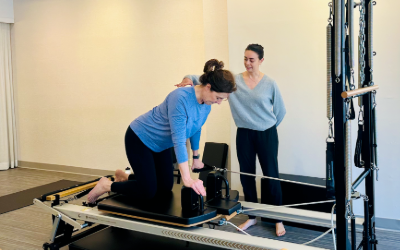
Instead of continuing to hammer abdominal exercises, we used a more diverse set of movements that still integrated her core while asking her hips, legs, trunk, and the rest of her body to share the work. This is one reason there isn’t a single type of Pilates that works for every person with back pain. The right approach depends on how the exercises are being performed, what your body is compensating for, and what you are ready to do. You can learn more about what kind of Pilates is best for back pain and what to consider when choosing an approach.
Your core does not work independently from your hips, pelvis, legs, rib cage, breathing, and spine.
At DBP, we take a fine-tuning approach:
- Can you create abdominal support without your back gripping?
- What changes if we adjust your position, range, resistance, or support?
- Can another part of your body contribute differently?
We want to separate the strength we want to build from the tension or compensation we don’t want to reinforce.
Rebecca puts it this way:
“The exercises you need to get out of back pain may be core exercises. They also may not be. The question is what your body needs in order to create strength without recreating the pain pattern.”
Should You Keep Doing a Pilates Exercise That Hurts Your Back?
If an exercise repeatedly aggravates your back, that gives us useful information.
Sometimes the movement needs a smaller range or more support. Sometimes another part of your body needs to contribute differently. Sometimes you have reached your current endurance limit.
And sometimes that exercise simply isn’t what you need right now.
The goal is to build strength without repeatedly recreating the pattern that aggravates your back.
It’s Hard to Trust Exercise When Exercise Keeps Hurting
It is difficult to convince yourself that an exercise is helping when every time you do it, your back hurts.
One DBP client who came to us with severe back pain and scoliosis described arriving “anxious and desperate,” and said that what mattered was that the work was responsive to what caused pain.
That is part of why personalized, one-on-one Pilates can matter. You need enough attention to understand what is happening, change the exercise when necessary, and experience movement that actually begins to feel different.
Pilates can be very effective for back pain, but “strengthen your core” is not a complete strategy. Sometimes the right answer is to modify a core exercise. Sometimes it is to stop piling on more abdominal work and build strength somewhere else first. The goal is strength that gives your body more options—not simply more strength layered over the same painful pattern.
Understand More About How Your Move With a Dynamic Body Assessment Session
If you’re trying to get stronger but aren’t sure which exercises are actually helping, a Dynamic Body Assessment Session can give you a more specific place to start. During the 90-minute session, Rebecca works with you one-on-one to understand how your body is moving and identify ways to modify, support, and progress your exercise appropriately.
If you’re also trying to understand how Pilates fits alongside other approaches to back pain, Pilates vs. physical therapy for back pain can help clarify what each approach is designed to do.
Ready to stop guessing at which exercises your back can handle? Learn about Pilates for back pain or get started with a complimentary 15-minute call.
FAQs About Pilates and Back Pain
Can Pilates make lower back pain worse?
Yes. Pilates can aggravate lower back pain when an exercise repeatedly places stress on an area that is already irritated or when the body compensates as the exercise becomes too difficult. Modifying the position, range of motion, resistance, or exercise itself may allow you to continue building strength without repeatedly aggravating your back.
Should I stop doing Pilates if my back hurts?
Not necessarily. If a Pilates exercise consistently causes or increases back pain, it is worth changing or stopping that particular movement rather than pushing through it. The appropriate modification depends on what is causing the discomfort and how your body is responding to the exercise.
Why does my back hurt during ab exercises?
Your back may begin to hurt during abdominal exercises when your abdominal muscles reach their current endurance limit and other muscles, including those around the back, begin contributing more of the work. Exercise position, range of motion, breathing, and technique can also affect how the work is distributed.
Is Pilates good for people with chronic back pain?
Pilates can be an appropriate form of exercise for some people with chronic back pain, particularly when exercises are adapted to the individual’s current abilities and symptoms. A personalized approach can help determine which movements to modify, which to avoid for now, and how to gradually build strength and movement capacity.

Rebecca Lubart is the founder and CEO of Dynamic Body Pilates, a one-on-one Pilates studio in New York City specializing in chronic pain, movement challenges, and healthy aging. With 20 years of experience teaching Pilates, Rebecca helps people better understand how their bodies move—and how strength, mobility, balance, and coordination work together.
Her approach grew in part from her own recovery from a traumatic injury and the search for more effective, whole-body solutions to persistent pain. She founded Dynamic Body Pilates in 2012 to bring that approach to others. Today, Rebecca and her team help clients move with greater comfort, confidence, and independence through highly individualized Pilates and movement education.