One of the biggest misconceptions people have about private Pilates is that it’s simply a more expensive version of a group Pilates class.
It isn’t.
Private Pilates and group Pilates were designed to accomplish different things. One isn’t inherently better than the other—they’re simply different tools for different goals.
One analogy I often use with clients is this:
If you were renovating your house, you wouldn’t spend thousands of dollars renovating and decorating it before making sure the foundation was solid.
Your body isn’t any different.
Many people invest in workouts, stretching, massage, or new fitness programs without first understanding the foundation they’re building on. If the way you stand, breathe, balance, or support yourself isn’t working well, adding more intensity or frequency often doesn’t solve the problem.
One of the reasons people end up frustrated is that they’re trying to solve a movement problem by doing more movement. More workouts. More stretching. More strengthening. But if your body is organizing itself inefficiently, doing more of the same strategy rarely changes the outcome. Before asking your body to work harder, it’s worth asking whether it has a better strategy available.
That’s where private Pilates can make all the difference.
What Is Private Pilates?
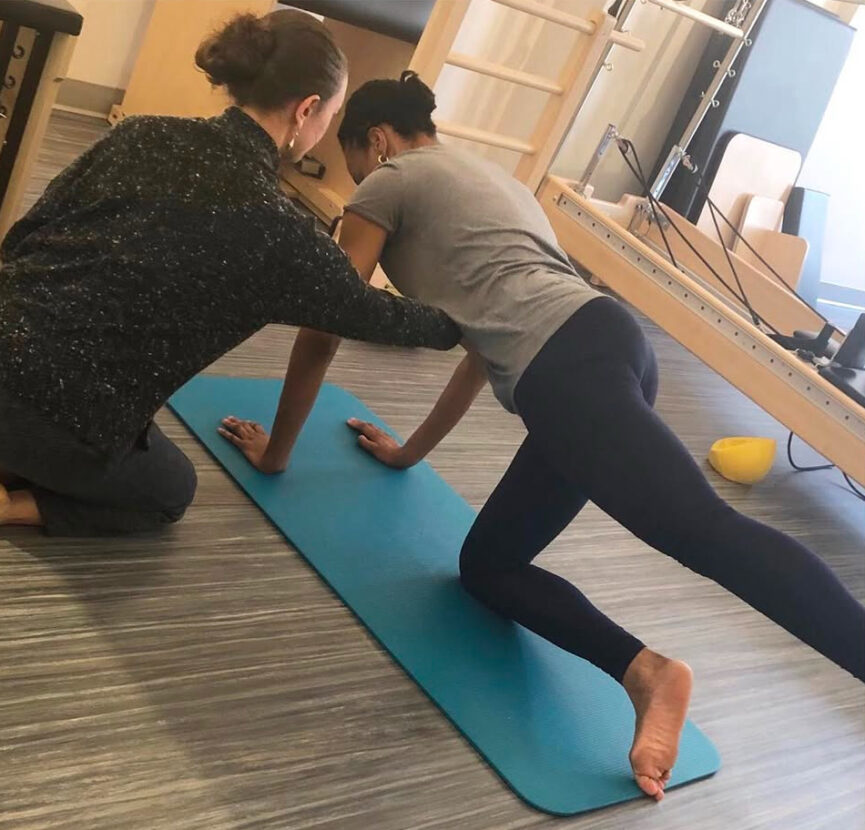
A private Pilates session is a one-on-one appointment with a trained instructor who evaluates how your body moves before creating an exercise strategy specifically for you.
Rather than following a predetermined workout, every exercise, cue, and progression is chosen based on your posture, breathing patterns, strength, mobility, goals, and movement compensations.
Private Pilates vs Group Pilates at a Glance
| Private Pilates | Group Pilates |
| One-on-one instruction | One instructor for many people |
| Personalized assessment | Standard class plan |
| Exercises adjusted every session | Same workout for everyone |
| Ideal for pain, injuries, surgery recovery | Ideal for healthy exercisers |
| Individual feedback | Limited personal correction |
| Progress based on your body | Progress based on class format |
What Group Pilates Does Really Well
Let’s start here, because group Pilates deserves more credit than it sometimes gets.
A well-taught group class can be an excellent way to build strength, improve mobility, stay accountable, and make movement a regular part of your life. If you’re generally healthy, enjoy exercising in a group, and are looking for a consistent, engaging workout, a Pilates class may be exactly what you need.
In fact, we often encourage clients to take group classes—when they’re the right fit. Usually that’s after they’ve developed enough body awareness to recognize when something doesn’t feel right, how to modify an exercise, and which muscles they’re actually trying to use. At that point, a group class becomes a place to build on what they’ve learned instead of guessing their way through it.
The question isn’t whether group Pilates is good.
The question is whether it’s the right tool for what you’re trying to accomplish.
Where Group Pilates Classes Reach Their Limits
Group classes are designed around a planned workout.
Private Pilates is designed around a person.
If you’ve been living with back pain, recovering from surgery, trying to return to exercise after years away, or simply noticing that your body doesn’t feel or perform the way it did ten years ago, your needs may not be the same as everyone else’s in the room.
That’s not a criticism of group Pilates.
It’s simply the reality of teaching a class.
An instructor leading a group has to balance the needs of everyone at once. A private practitioner can spend the entire hour observing how you breathe, how you stand, how you move, where you’re compensating, and what your body needs next.
That’s a very different experience—and a very different job.
What Happens in a Private Pilates Session?
One of the biggest differences between private Pilates and a group class isn’t the equipment or even the exercises. It’s the decision-making happening behind the scenes.
In a group class, the instructor is guiding everyone through the same workout while offering modifications when needed. In a private session, every exercise begins with a question:
“What does this person’s body need today?”
That answer isn’t based on a diagnosis alone. It’s based on observation.
Before deciding what to teach next, we’re constantly paying attention to how you breathe, how you stand, how your joints move, where you create unnecessary tension, how you balance, and where your body compensates when something feels difficult. Those details help us understand not just where you have pain, but why your body may be relying on certain movement patterns.
Sometimes the right next step isn’t making an exercise harder. It’s choosing a different exercise altogether. Other times it’s changing your position, adjusting the equipment, simplifying the movement, or giving one cue that helps everything else fall into place.
That ongoing process is called clinical reasoning—using observation, experience, and your response to movement to make thoughtful decisions throughout the session rather than simply following a predetermined workout.
The goal isn’t to make you dependent on one-on-one instruction forever.
It’s to help you better understand how your body moves so you can make better decisions whether you’re lifting weights, hiking, taking a group Pilates class, or simply going about your day.
That’s why no two private Pilates sessions look exactly alike—even if two people come in with the same diagnosis.
Because no two bodies move exactly the same way.
Here’s What That Looks Like in Real Life
One client comes to mind immediately.
When Jasmine first came to Dynamic Body Pilates, she wasn’t looking for rehabilitation. She wanted to get stronger.
She was a software engineer with a demanding desk job. She had a personal trainer, was seeing a physical therapist twice a week for hamstring tendinitis, visited a massage therapist every month, and exercised consistently because she genuinely enjoyed getting stronger. She wanted to move well, hurt less, and build a body she could trust for decades to come.
On paper, she was doing everything “right.”
But her body told a different story.
She was dealing with hamstring tendinitis behind her knee, chronic neck and shoulder pain, recurring rib pain, low back pain during certain core exercises, a new hip issue, occasional ankle pain, and wrists that flared up during push-ups.
When I read her intake form, though, those weren’t the sentences that stood out to me.
It was these:
“I don’t like when I’m not sure if I’m doing an exercise properly or if it feels like it’s causing the wrong type of pain.”
“Not wanting to be limited by my body’s weaknesses.”
She wasn’t afraid of hard work.
She was afraid of working hard and still ending up in pain.
Then she said something during her assessment that I’ve never forgotten.
“My last Pilates teacher gave me lots of corrections all at once and it was hard to keep track. I really need one thing at a time. Please don’t teach past me.”
That sentence completely changed how I approached her sessions.
Jasmine didn’t need more information.
She needed someone to slow down enough that she could actually learn.
She wanted to get stronger, but coordinating her breath, moving her arms and legs independently, and finding the muscles she was actually trying to strengthen was surprisingly difficult. If I gave her too many cues at once, she became overloaded. So we kept it simple.
One cue.
One success.
Then another.
Over the next two years, we celebrated things that probably wouldn’t look impressive from the outside. She learned how to organize her posture instead of simply standing taller. She learned how to stack her spine, stabilize one part of her body while another moved, and use her breath instead of holding it through difficult exercises. She became more aware of where her body was in space. She stopped relying on tension to create strength.
As those skills improved, so did everything else.
We gradually added free weights, more challenging strength work, pull-ups, push-ups, and exercises that complemented the personal training she loved. Pilates didn’t replace the rest of her fitness. It became the foundation that made the rest of it work better.
Eventually, Jasmine emailed me to say she wanted to try a group Pilates studio closer to home.
I wasn’t disappointed.
I knew she was ready.
Not because she no longer needed Pilates, but because she no longer needed every decision to be made for her. She had developed the body awareness to recognize when something didn’t feel right, the confidence to modify when it didn’t, and the understanding to continue learning in a group environment.
She wasn’t leaving private Pilates behind.
She was taking everything she’d learned with her.
Afterward, she left us this review:
“Through DBP, my posture has improved significantly, and my movements are pain-free. I pay more attention to how I move now outside of Pilates.”
That last sentence is my favorite.
Not because it mentions Pilates.
Because it doesn’t.
To me, that’s the real purpose of private Pilates.
Not to create lifelong dependence on one-on-one sessions, but to help people understand their bodies well enough that whether they’re working with a trainer, taking a group class, skiing, hiking, or simply living their everyday lives, they know how to support themselves.
So…Which Is Right for You?
If you’re looking for a fun, challenging workout and generally feel confident in your body, a group Pilates class may be exactly what you need.
But if you’re dealing with pain, returning to exercise after time away, recovering from an injury, unsure whether you’re doing exercises correctly, or simply want to understand your body before asking it to work harder, private Pilates offers something different.
Is Private Pilates worth it?
If your goal is simply to get a good workout, a group Pilates class may be all you need.
But if you’ve been dealing with recurring pain, recovering from an injury, feeling frustrated that exercise isn’t helping the way you expected, or wondering whether you’re doing the right exercises for your body, private Pilates can help you build a stronger foundation before adding more challenge.
Rather than spending each session following a predetermined workout, you’re learning how your body moves, where it compensates, and what strategies help you move with greater confidence. Those are skills you can carry into every workout and every activity you enjoy.
Should beginners start with private or group Pilates?
It depends on the beginner.
If you’re healthy, active, and simply looking for a new way to exercise, a well-taught group class can be a great place to start.
But if you’re returning to exercise after years away, recovering from surgery or physical therapy, managing chronic pain, or feeling uncertain about how your body moves, beginning with private Pilates often makes the transition easier.
Instead of trying to keep up with a class, you have the opportunity to ask questions, move at your own pace, and develop the confidence to know when something feels right—and when it doesn’t.
Can I transition from private Pilates to group classes?
Absolutely.
In fact, that’s often the goal.
One of the greatest measures of success isn’t that someone stays in private sessions forever. It’s that they develop enough body awareness and confidence to continue moving well wherever they choose—whether that’s a group Pilates class, strength training at the gym, hiking, skiing, yoga, or simply keeping up with everyday life.
Private Pilates isn’t designed to create dependence.
It’s designed to help you become a more informed, confident mover so you can continue building on that foundation long after you leave the studio.
Your Goals Should Be the Deciding Factor
When your goals are specific, your Pilates should be too.
Ultimately, private Pilates offers the opportunity to slow down long enough to build a foundation.
Once you understand how your body organizes itself, how to support your posture, breathe efficiently, and recognize when something doesn’t feel right, those skills don’t stay in the studio. They follow you into every workout, every hike, every ski trip, every strength training session, and every ordinary day.
That’s why I don’t think private Pilates is better than group Pilates.
I think they’re different tools designed for different jobs.
For many people, private Pilates is where they learn to trust their bodies again. A group class is where they continue building on that foundation.
Your Next Step Depends on Your Body, Not a Formula
When it comes to Pilates, the right choice isn’t about choosing the “better” option.
It’s about choosing the right tool for where you are right now.
For some people, a group class provides exactly what they need: a consistent practice, a challenging workout, and a community that keeps them moving.
For others, private Pilates provides the space to slow down, understand their movement patterns, and build the foundation they need to feel stronger and more confident.
Your body has its own history. Your goals, injuries, habits, and movement patterns all play a role in what will help you move better.
That’s why private Pilates begins with understanding you first.
If you’re curious whether one-on-one Pilates is the right fit for your goals, we’d be happy to help you explore what your body needs and what approach makes the most sense for you.
Start with a 15-minute complimentary call to determine if private pilates is the right fit. If it is, we can discuss the next step.
Private Pilates vs Group Pilates FAQs
Is Private Pilates better than Group Pilates?
Private Pilates isn’t necessarily better than group Pilates. They’re designed for different purposes.
Group classes are a great option for people who want a challenging workout in a supportive environment. Private Pilates is better suited for those who want individualized guidance, are working through pain or limitations, or want to better understand how their body moves.
The best choice depends on your goals, experience, and what your body needs right now.
Who benefits most from one-on-one Pilates?
Private Pilates is especially helpful for people who are dealing with pain, recovering from an injury or surgery, returning to exercise after time away, or feeling unsure whether they’re performing exercises correctly.
It’s also valuable for active people who want to improve their movement patterns, prevent recurring issues, or build a stronger foundation for other activities.
Is Private Pilates worth the investment?
For many people, the value of private Pilates goes beyond the workout itself.
You’re not just learning exercises. You’re learning how your body moves, where you may be compensating, and what strategies help you move with more confidence.
Those skills carry into everything you do, from strength training and sports to everyday activities.
Can Private Pilates help after physical therapy?
Yes. Many people continue with private Pilates after physical therapy to maintain their progress, rebuild strength, and develop better movement habits.
While Pilates isn’t a replacement for physical therapy, it can be a valuable next step for learning how to move confidently after an injury or treatment.
Can I transition from private Pilates to group classes?
Absolutely. In fact, that’s often the goal.
Private Pilates can help you develop the body awareness and confidence to participate in group classes with a better understanding of how to modify exercises and listen to your body.
Many clients use private sessions as a foundation before continuing their Pilates practice in a group setting.
How many private Pilates sessions do most people need?
It depends on your goals, movement history, and what you’re hoping to accomplish.
Some people benefit from a few sessions to build awareness and establish a foundation. Others choose ongoing private Pilates as part of their long-term approach to strength, mobility, and staying active.
The right number of sessions is different for every person and can be discussed during your initial consultation.

Rebecca Lubart is the founder and CEO of Dynamic Body Pilates, a one-on-one Pilates studio in New York City specializing in chronic pain, movement challenges, and healthy aging. With 20 years of experience teaching Pilates, Rebecca helps people better understand how their bodies move—and how strength, mobility, balance, and coordination work together.
Her approach grew in part from her own recovery from a traumatic injury and the search for more effective, whole-body solutions to persistent pain. She founded Dynamic Body Pilates in 2012 to bring that approach to others. Today, Rebecca and her team help clients move with greater comfort, confidence, and independence through highly individualized Pilates and movement education.