Yes. Pilates can help many people with back pain, particularly chronic low back pain. Research has found that Pilates-based exercise can reduce pain and improve disability and function”.1, 2
But that doesn’t mean Pilates is a magic solution—or that it is necessarily better than every other thoughtfully designed form of exercise. A Cochrane review found Pilates more effective than minimal intervention for pain and disability, but did not find clear evidence that it was superior to other forms of exercise.3
What seems to matter is finding movement that your body can tolerate, progressively building strength and capacity, and choosing an approach that fits your particular needs.
Why Can Pilates Help Back Pain?
Back pain often changes the way you move.
You may stop bending a certain way, brace before lifting something, avoid rotation, or give up an activity because you’re worried about another flare-up.
Those strategies can be useful when something hurts. But if they become permanent, your world can gradually get smaller.
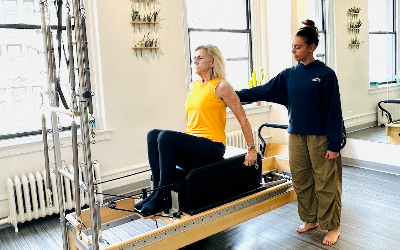
Pilates gives you a controlled environment to practice movement while developing strength, mobility, coordination, and confidence. For people dealing with ongoing pain, that can mean gradually finding ways to move that feel more comfortable and capable.
And it shouldn’t mean spending an hour doing abdominal exercises.
Your core doesn’t work in isolation. What matters is how it integrates and coordinates with your hips, legs, rib cage, breathing, balance, and the rest of your body as you move.
If your back is consistently taking on more work than it should, strengthening your abdominals alone may not address why that is happening.
Rebecca Lubart, founder of Dynamic Body Pilates and a Pilates practitioner with nearly 20 years of experience, puts it this way:
“If twenty people with back pain walked into our studio, they’d get twenty different workouts.”
One person may need more mobility. Another may already be very flexible and need greater strength or control. Someone may want to return to running or weightlifting, while someone else simply wants to sit through a workday comfortably.
Knowing where you hurt doesn’t tell us everything your session needs to address—or how we should approach the movements and areas that are aggravating you.
[VIDEO: Can Pilates Help Back Pain?]
What Does the Research Say?
There is meaningful research supporting Pilates for chronic low back pain.
Systematic reviews and randomized controlled trials have found that Pilates can reduce pain and disability compared with little or no exercise.
But the research does not consistently show that Pilates is superior to every other well-designed form of exercise.
As Rebecca says:
“It would be great if there were one universally best exercise for back pain. That’s not a thing. A lot of the content promising otherwise is basically clickbait.”
The more useful question is not, What is the best exercise for back pain?
It is: What does this particular person need to move better, feel stronger, and do more?
What Does “Helping Back Pain” Actually Look Like?
Pain reduction matters. But it isn’t the only measure of success. For many people, the bigger goal is getting something back. Moving with less pain can open up possibilities that have gradually become harder to access.
Running. Traveling. Going to the gym. Picking up a grandchild. Sitting through dinner. Getting out of bed without immediately thinking about your back.
One Dynamic Body Pilates client described that shift simply:
“I started at Dynamic Body Pilates seeking help for low back pain… I also wanted to run for fitness but couldn’t. Well, now I can run.” — Chris K.
That is ultimately what we want Pilates to accomplish.
Not simply a body that can perform Pilates exercises, but a body with enough strength, movement options, and confidence to participate more fully in life.
Is Pilates Worth Considering for Back Pain?
For many people, yes—particularly when the program can adapt to their symptoms, abilities, and goals.
But “try Pilates” is only the beginning of the answer.
The next question is what kind of Pilates—and what level of individualization—you need.
If your back pain is new, severe, or unexplained, it’s important to have it appropriately evaluated before beginning a new exercise program. If you’re ready to explore whether individualized Pilates could help you move with less pain and more confidence, a Dynamic Body Assessment Session is a good place to start. We’ll look at how you move, what you’re experiencing, and what you want to be able to do so we can determine how Pilates may fit into your goals.
FAQs About How Pilates Helps With Back Pain
Can Pilates help with chronic lower back pain?
Yes. Research suggests Pilates can reduce pain and disability and improve function for people with chronic low back pain. However, research does not consistently show that Pilates is more effective than other well-designed forms of exercise. The right approach depends on the individual, their symptoms, abilities, and goals.
How does Pilates help with back pain?
Pilates can help you practice movement while developing strength, mobility, coordination, and control. Rather than focusing only on the abdominal muscles, an individualized Pilates program considers how your hips, legs, rib cage, breathing, balance, and spine work together during movement.
Is Pilates safe if I have back pain?
Pilates may be appropriate for many people with back pain when exercises are adapted to their symptoms, abilities, and goals. If your back pain is new, severe, or unexplained, it’s important to have it appropriately evaluated before starting a new exercise program.
What type of Pilates is best for back pain?
There isn’t one type of Pilates or one exercise program that is best for everyone with back pain. A personalized approach can account for how you move, what movements aggravate your symptoms, your current strength and mobility, and what you want to return to doing.
References
1. Yu Z, Yin Y, Wang J, et al. Efficacy of Pilates on Pain, Functional Disorders and Quality of Life in Patients with Chronic Low Back Pain: A Systematic Review and Meta-Analysis. International Journal of Environmental Research and Public Health. 2023;20(4):2850. DOI: 10.3390/ijerph20042850.
2. Huang J, Park H-Y. Effect of Pilates Training on Pain and Disability in Patients with Chronic Low Back Pain: A Systematic Review and Meta-Analysis Based on Randomized Controlled Trials. Physical Activity and Nutrition. 2023;27(1):16–29. DOI: 10.20463/pan.2023.0003.
3. Yamato TP, Maher CG, Saragiotto BT, et al. Pilates for low back pain. Cochrane Database of Systematic Reviews. 2015.

Rebecca Lubart is the founder and CEO of Dynamic Body Pilates, a one-on-one Pilates studio in New York City specializing in chronic pain, movement challenges, and healthy aging. With 20 years of experience teaching Pilates, Rebecca helps people better understand how their bodies move—and how strength, mobility, balance, and coordination work together.
Her approach grew in part from her own recovery from a traumatic injury and the search for more effective, whole-body solutions to persistent pain. She founded Dynamic Body Pilates in 2012 to bring that approach to others. Today, Rebecca and her team help clients move with greater comfort, confidence, and independence through highly individualized Pilates and movement education.