If you’re wondering whether reformer Pilates is good for beginners, the short answer is yes. You do not need to be strong, flexible, athletic, or experienced in Pilates before getting on a reformer.
And there isn’t only one kind of beginner.
You may be a beginner because you’ve never exercised very much. You may already be active but have never done Pilates. Or you may have plenty of exercise experience but pregnancy, postpartum recovery, an injury, aging, or time away from exercise has changed what your body needs now.
The reformer can be an especially beginner-friendly place to start because its springs, straps, footbar, and moving carriage give an instructor many ways to provide support, resistance, and feedback.
But there is an important distinction:
While the reformer can be extremely beginner-friendly, a reformer Pilates class is not automatically beginner-friendly.
How successful your first experience is depends less on the machine itself and more on how the Pilates is being taught, and whether the exercises, resistance, pace, and amount of support are appropriate for you. That’s where private Pilates can make a difference.
Why Is Reformer Pilates Good for Beginners?
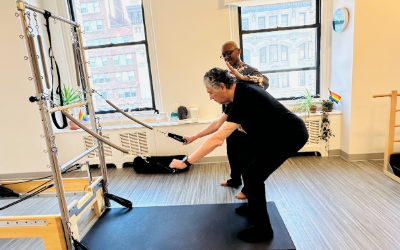
The Pilates reformer is a piece of equipment with a sliding carriage, adjustable springs, straps, and a footbar.
Those different parts allow the reformer to both help you and challenge you.
The springs can provide resistance when you’re building strength, but they can also provide assistance when a movement would otherwise be difficult. The straps can support your arms or legs. The footbar gives you something stable to press against. And because the carriage moves, you get feedback about how well you’re controlling the movement.
That can be particularly helpful when you’re learning.
You don’t need to arrive already knowing how to move well. The equipment gives your instructor more information about what you’re doing and more ways to help you understand the movement.
The Reformer Gives You Feedback
One of the hardest things about learning any new type of exercise is knowing what your body is actually doing.
You may think you’re pushing evenly through both legs when one side is doing most of the work. You may not realize you’re shifting your weight or holding your breath when something becomes difficult.
The reformer gives both you and your instructor information.
Does the carriage move smoothly? Does one leg seem to push more strongly? Can you control the movement in both directions? Do you feel more stable with a little more support?
You don’t need to analyze every movement yourself. Your instructor can use that information to help you find a better way to move.
What Is Reformer Pilates? A Beginner’s Guide goes into more detail about how the equipment works and what makes reformer Pilates different from other forms of Pilates.
What Does It Mean to Be a Beginner?
You might think of yourself as a beginner because you’ve never exercised very much at all.
Maybe you’ve never considered yourself athletic. Maybe gyms and fitness classes have never felt particularly comfortable. Maybe you’re simply ready to get stronger and don’t know where to start.
But you can also feel like a beginner even if you have plenty of exercise experience.
You might run, cycle, lift weights, practice yoga, or take fitness classes and have never done Pilates. Pilates may ask you to pay attention to your body in ways that feel completely new.
And sometimes you’re experienced with exercise, but you’re learning how to exercise in the body you have now.
Pregnancy can change your balance, posture, strength, flexibility, and the way exercise feels. After having a baby, movements that used to feel familiar may suddenly feel very different.
The same can happen after surgery, physical therapy, an injury, a long break from exercise, or simply as your body changes with age.
Being a beginner doesn’t necessarily mean you’ve never exercised. It means there is something new you’re learning about how to exercise in your body now.
As adults, we’re used to knowing how to do things. We don’t often give ourselves opportunities to be true beginners, and it can feel surprisingly uncomfortable not to know what you’re doing yet.
Pilates asks you to give yourself a little room to learn.
DBP client Laurie A. described the studio as such an “accepting, non-judgmental environment” that she was able to stop worrying about her insecurities about being a beginner and simply enjoy the process.
That’s what a good beginner experience should allow you to do: learn instead of worrying about whether you’re already good at Pilates.
Is Reformer Pilates Hard for Beginners?
Reformer Pilates can certainly be challenging.
But you shouldn’t feel as though you have to prove you’re capable of keeping up before you’re ready to do it.
The more useful question is whether the Pilates is being matched to your current skill level, body, and goals.
At Dynamic Body Pilates, we can change the exercise, spring resistance, position, range of motion, amount of support, or pace based on what you need.
If you’re new to exercise, you may need more time to develop basic strength, coordination, flexibility, and confidence.
If you’re already athletic but new to Pilates, you may be ready for considerably more physical challenge while still learning a different way of moving.
The goal isn’t to make every beginner do the same workout at a lower level.
It’s to find the version of the exercise that makes sense for the person in front of you.
When I work with someone new, I tell them we’re going to go one step at a time. If something doesn’t feel right, I want to know as soon as they have that thought so we can adjust. There is no value in pushing through an exercise just to say you completed it.
The goal is to find the version that allows you to move well, build strength and mobility, and keep progressing from there.
Do You Need to Do Mat Pilates Before Reformer Pilates?
No. You do not need to do mat Pilates before starting reformer Pilates.
For many beginners, the reformer can actually make Pilates more accessible.
The springs, straps, and footbar can provide support while you’re developing strength, give you something to press or pull against, and help you understand what your body is doing.
There can be tremendous value in mat work, particularly when you know how to perform the exercises efficiently. Many mat-based Pilates exercises can also be performed on the reformer or incorporated into a reformer session.
But mat Pilates isn’t a prerequisite.
The reformer gives an instructor more options for adjusting assistance, resistance, and progression, which can make it a useful place to start when you’re learning.
When Is Private Reformer Pilates a Better Starting Point?
Not every beginner needs private Pilates.
If you’re healthy, confident exercising, comfortable learning in a group, and joining a genuinely beginner-level reformer class, a group setting may be a perfectly good place to start.
Private instruction becomes particularly valuable when there is more for the instructor to take into account.
You may benefit from starting one-on-one if:
- You’re new to exercise or haven’t exercised consistently in a long time.
- You’re dealing with back pain, an injury, surgery, or another physical consideration.
- You’re pregnant, postpartum, or adjusting to physical changes related to pregnancy and birth.
- You have concerns about balance, mobility, coordination, or getting on and off the equipment.
- You learn better when someone can slow down, explain, and respond to you in real time.
- You have specific goals you want your Pilates program to address.
The advantage isn’t simply getting “more attention.” It’s that Pilates can change based on what your body needs.
If an exercise isn’t working for you, your instructor can change the resistance, position, cue, range of motion, equipment, or exercise immediately. You don’t have to continue doing something that doesn’t make sense for your body simply because everyone else in the room is doing it.
That’s what stood out to DBP client Ndidi O., who came to the studio new to Pilates. She recommends the experience for beginners looking for “a customized program to help improve your overall movement, balance, and strength,” along with clear guidance and feedback on each exercise.
At Dynamic Body Pilates, new clients begin with an individual assessment of their strength, flexibility, posture, balance, coordination, movement, health history, and goals.
We’re not assessing whether you’re “good enough” to do reformer Pilates.
We’re figuring out where to begin.
What Should Your First Reformer Pilates Session Be Like?
If you’re nervous about your first session, you shouldn’t need to know anything about the reformer before you arrive.
Your instructor should teach you how the equipment moves, what the springs do, and how to position yourself safely and comfortably. From there, the exercises should be chosen based on what you’re ready to do, not based on how much Pilates you already know.
At DBP, your first session may include exercises lying down, sitting, standing, on the reformer, or using other Pilates equipment.
Reformer footwork is often included, but there isn’t one exercise everyone needs to begin with.
Some exercises may feel simple. Others may challenge your strength, flexibility, balance, or coordination.
You don’t need to perform them perfectly.
You’re there to learn.
In fact, one of the things I sometimes tell a new client at the end of a session is:
“Nothing we did today was something you couldn’t do before. You just needed me to guide you there so you could feel that your body was capable of it.”
That’s what those first sessions can begin to give you: not simply a collection of new exercises, but a better understanding of what your body can do and a path toward doing more.
What Should You Look for in Beginner Reformer Pilates?
If you’re comparing reformer Pilates studios, don’t only ask whether they offer beginner classes.
Think about what beginner means in that environment.
- Will the instructor know anything about your body before you begin?
- Will you be shown how to use the equipment?
- Can exercises be modified if something doesn’t feel right?
- Will you have enough individual guidance to understand what you’re doing?
- Does the environment make sense for your current fitness level, health history, and goals?
There isn’t one correct way for every beginner to start reformer Pilates.
But you should feel that you’re learning, not simply trying to keep up.
Reformer Pilates Should Meet You at the Beginning
You don’t need to get stronger before starting reformer Pilates.
You don’t need to become more flexible. You don’t need to consider yourself athletic. You don’t need to have a particular body type or size. And you don’t need to do mat Pilates first.
You may be new to Pilates, new to exercise, or simply learning what exercise looks like in your body now.
Reformer Pilates can work for many different kinds of beginners because it doesn’t have to look the same for all of them.
What matters is finding the right starting point for you.
At Dynamic Body Pilates in NYC, all of our Pilates work is one-on-one. We work with people across a wide range of body types, sizes, ages, fitness levels, physical conditions, and movement histories.
Your first step isn’t proving you’re ready for Pilates.
It’s finding the right place to begin.
Schedule a 15-minute complimentary call.
FAQs About Reformer Pilates for Beginners
Yes. You don’t need previous Pilates or exercise experience to start. Exercises, spring resistance, range of motion, and support can be adjusted to your current strength, flexibility, coordination, and confidence.
It shouldn’t be if the work is appropriately matched to you. The reformer can provide more assistance when you need it and progressively more challenge as your strength, flexibility, and coordination improve.
No. Reformer Pilates can be adapted for many body types, sizes, ages, fitness levels, and physical conditions. You don’t need to be strong, flexible, athletic, or already exercising regularly before you begin.
No. The reformer’s springs, straps, and footbar can provide assistance and feedback that make many movements more accessible to a beginner. Mat work can be valuable, but it isn’t a prerequisite.
It can be, but back pain varies from person to person. Exercise selection should reflect your symptoms, movement, strength, flexibility, and history rather than relying on one standard “back-friendly” routine.
It depends. A healthy, confident beginner may do well in an introductory class, while someone with pain, pregnancy or postpartum changes, specific physical conditions, balance concerns, or little exercise experience may benefit more from individualized instruction.
For many beginners, one or two sessions per week provides enough consistency to learn the work and build strength. The right weekly frequency depends on your goals, activity level, physical considerations, and recovery.
Rebecca Lubart is the founder and CEO of Dynamic Body Pilates, a one-on-one Pilates studio in New York City specializing in chronic pain, movement challenges, and healthy aging. With 20 years of experience teaching Pilates, Rebecca helps people better understand how their bodies move—and how strength, mobility, balance, and coordination work together.
Her approach grew in part from her own recovery from a traumatic injury and the search for more effective, whole-body solutions to persistent pain. She founded Dynamic Body Pilates in 2012 to bring that approach to others. Today, Rebecca and her team help clients move with greater comfort, confidence, and independence through highly individualized Pilates and movement education.