The best Pilates for back pain isn’t defined by mat, Reformer, or one particular style. It’s Pilates that helps you understand how your body is moving, build the skills you need to move differently, and apply those skills beyond the studio.
If you’re still wondering whether Pilates can help with back pain in the first place, start with our guide to whether Pilates can help with back pain. Once you’ve established that Pilates may be useful for your situation, the more important question becomes: what kind of Pilates is right for you?
You may also see this described as therapeutic Pilates, rehab Pilates, or rehabilitative Pilates. Those labels can be useful, but they don’t tell you how individualized or comprehensive the work will be.
Research does not point to one universally superior type of exercise for chronic low back pain.1 Two people can hurt in the same place and still need very different things.
The best Pilates for back pain isn’t defined by mat, Reformer, or one particular style. It’s Pilates that helps you understand how your body is moving, build the skills you need to move differently, and apply those skills beyond the studio.
You may also see this described as therapeutic Pilates, rehab Pilates, or rehabilitative Pilates. Those labels can be useful, but they don’t tell you how individualized or comprehensive the work will be.
Research does not point to one universally superior type of exercise for chronic low back pain.1 Two people can hurt in the same place and still need very different things.
As Dynamic Body Pilates founder Rebecca Lubart explains:
“The best Pilates for back pain should help you build a skill set—not just learn a collection of exercises—so you have tools you can eventually apply in any movement environment.”
The Best Approach Should Help You Understand What Your Body Is Doing
Back pain can be influenced by how your hips, legs, pelvis, rib cage, trunk, and spine coordinate. One area may be doing more because another isn’t contributing effectively.
A biomechanics-informed approach asks: Where are you generating force? Where are you compensating? What provides stability? What changes when we alter your position, resistance, or range?
One DBP client described discovering exactly that:
“It turns out my neck and back issues were partly due to imbalances in my legs and feet. No other practitioner had raised that issue before.” — Andrew M.
The goal isn’t a diagnosis-based list of “back exercises.” It’s understanding enough about your movement to make thoughtful choices about what to work on and why.
Mat vs. Reformer Pilates for Back Pain
Both mat and equipment-based Pilates can be useful.
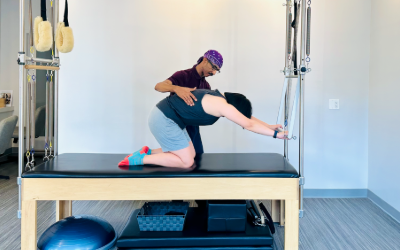
Pilates equipment lets us change support and resistance, isolate part of a movement, or add challenge. Mat work asks you to organize your body against gravity and can make certain skills easier to practice outside the studio.
At DBP, neither is the “back pain version” of Pilates.
What are we trying to teach your body, and which environment helps us teach it best?
Often, the answer includes both.
A Comprehensive Program Should Build More Than Core Strength
Core strength matters. But so can hip mobility, leg strength, balance, spinal mobility, breathing, coordination, and the ability to integrate those skills.
Your program may include work on your feet, hips, balance, rotation, or how your trunk organizes while your arms and legs create force.
The point is not to collect exercises. It is to build strength, flexibility, coordination, awareness, and movement strategies you can use elsewhere.
Is Private Pilates Better for Back Pain?
Not everyone with back pain needs private Pilates. Someone with mild, predictable symptoms who already understands how to modify exercise may do well in a thoughtfully taught group class.
But back pain often comes with fear of making things worse. You may hesitate to bend, twist, load your spine, or try something new because you’re not sure what is safe.
That is where private Pilates can be especially valuable.
One-on-one attention gives you room to slow down, ask questions, and understand what you’re doing. Your practitioner can watch how you move, adjust an exercise in real time, and help you distinguish between something that needs modification and something that is simply unfamiliar or challenging.
Private Pilates can also be useful when symptoms are persistent or changing, several areas may be contributing, or previous exercise has aggravated your back.
For many people, that attention helps rebuild confidence in movement.
Research on chronic nonspecific low back pain has found benefits from individually designed exercise programs, supporting the idea that how exercise is tailored can matter alongside the method itself.2
Your Pilates Should Work Outside the Studio
The goal isn’t to become excellent at Pilates exercises under perfectly controlled conditions.
It’s to build skills you can use while walking, lifting weights, running, climbing stairs, traveling, or picking something up from the floor.
Andrew M. described DBP’s one-on-one work as helping him get “the subtleties of the movements just right,” both during sessions and while practicing at home.
Sophie R. described receiving “great, clear feedback that’s easy to take out of the studio and into the real world.”
That transfer matters. Your Pilates should increasingly prepare you for the activities that matter outside the studio.
So, What Pilates Should You Choose for Back Pain?
Look beyond whether a program calls itself mat Pilates, Reformer Pilates, therapeutic Pilates, rehab Pilates, or rehabilitative Pilates.
Ask whether the approach can:
- Account for how your whole body is moving
- Address more than the painful area
- Build strength, flexibility, and coordination together
- Adapt as your body responds
- Help you understand what you’re doing and why
- Progress toward the activities that matter in your life
At Dynamic Body Pilates, back pain work is one-on-one and individualized. Your sessions are built around how you move, what you’re experiencing, and what you want to be able to do. The goal is not simply to give you a collection of exercises for your back. It’s to help you develop movement skills you can use in and beyond the studio.
If you’re not sure whether private Pilates is appropriate for your back pain, a complimentary 15-minute call is a good place to start. We can talk through what you’re experiencing, what you’ve tried, and whether our approach makes sense for you.
Schedule a complimentary 15-minute call to discuss your back pain and your goals.
FAQs About The Best Kind of Pilates for Back Pain
What type of Pilates is best for lower back pain?
The best type of Pilates for lower back pain is an approach that can be adapted to the individual rather than one specific format such as mat or Reformer Pilates. A personalized program can address strength, mobility, coordination, balance, and movement patterns based on the person’s needs.
Is Reformer Pilates good for back pain?
Reformer Pilates can be appropriate for some people with back pain because the equipment allows exercises to be modified through changes in resistance, support, positioning, and range of motion. Whether it is appropriate depends on the individual and how the exercises are selected and taught.
Is private Pilates better for back pain?
Private Pilates can be particularly useful for people with persistent, changing, or complex back pain because the instructor can observe movement closely, modify exercises in real time, and tailor the program to the individual. However, private Pilates is not necessary for everyone with back pain.
Can Pilates make back pain worse?
Pilates can aggravate back pain if exercises are poorly matched to a person’s current abilities, symptoms, or movement needs. Pain during or after exercise does not necessarily mean damage has occurred, but new or worsening symptoms should be evaluated and the exercise program adjusted as appropriate.
References
1. Wong CM, Rugg B, Geere JA. The effects of Pilates exercise in comparison to other forms of exercise on pain and disability in individuals with chronic non-specific low back pain: A systematic review with meta-analysis. Musculoskeletal Care. 2023;21(1):78–96.
2. Fleckenstein J, Floessel P, Engel T, et al. Individualized Exercise in Chronic Non-Specific Low Back Pain: A Systematic Review with Meta-Analysis on the Effects of Exercise Alone or in Combination with Psychological Interventions on Pain and Disability. The Journal of Pain. 2022;23(11):1856–1873.
Rebecca Lubart is the founder and CEO of Dynamic Body Pilates, a one-on-one Pilates studio in New York City specializing in chronic pain, movement challenges, and healthy aging. With 20 years of experience teaching Pilates, Rebecca helps people better understand how their bodies move—and how strength, mobility, balance, and coordination work together.
Her approach grew in part from her own recovery from a traumatic injury and the search for more effective, whole-body solutions to persistent pain. She founded Dynamic Body Pilates in 2012 to bring that approach to others. Today, Rebecca and her team help clients move with greater comfort, confidence, and independence through highly individualized Pilates and movement education.